chapter 7: 2-Rescuer CPR and Bag-Mask Ventilation
When two trained rescuers are available, CPR should be performed as a coordinated team. One rescuer should take a leadership role to coordinate tasks, monitor quality, and direct compressor switches. Team-based CPR improves compression quality, reduces fatigue, and supports effective ventilation.
Adult 2-Rescuer CPR
Rescuer 1 – Compressions
- Begin chest compressions immediately.
- Compress at least 2 inches (5 cm), but no more than 2.4 inches (6 cm).
- Maintain a rate of 100–120 compressions per minute.
- Allow full chest recoil after each compression.
- Minimize interruptions (no more than 10 seconds).
- Switch compressors about every 2 minutes (or sooner if fatigued).
Compression-to-Ventilation Ratio (Adults)
- 30 compressions to 2 breaths (30:2)
Rescuer 2 – Airway and Ventilation
- Open the airway using the head-tilt, chin-lift (unless spinal injury suspected).
- Deliver breaths using a bag-mask device.
- Provide 2 breaths after each compression cycle.
- Each breath should last about 1 second and produce visible chest rise.
- Avoid excessive ventilation.
- Monitor compression quality and prepare the AED.
- Coordinate compressor switches efficiently to limit pauses.
Using a Bag-Mask Device (BVM)
A bag-mask device is commonly used in healthcare settings to deliver assisted ventilation.
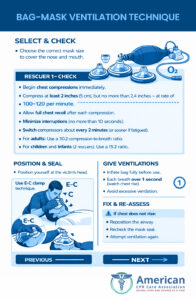
- Select the correct mask size to create a proper seal over the nose and mouth.
- Use the E-C clamp technique to hold the mask:
- “C” forms a seal with a thumb and index finger.
- “E” lifts the jaw to maintain airway position.
- Attach the bag to oxygen when available (up to 15 L/min).
- Squeeze the bag just enough to produce visible chest rise.
- Deliver each breath over 1 second.
- Provide only enough volume to produce visible chest rise.
- If the chest does not rise:
- Reposition the head.
- Re-establish the mask seal.
- Check for visible airway obstruction.
High-quality CPR in a team setting works best when everyone communicates clearly, keeps interruptions short, uses proper ventilation technique, switches roles often to prevent fatigue, and encourages one another to stay strong and focused.